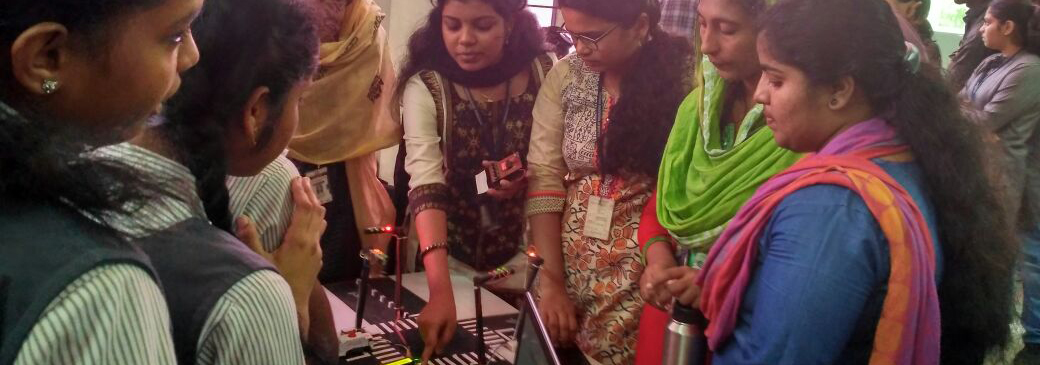
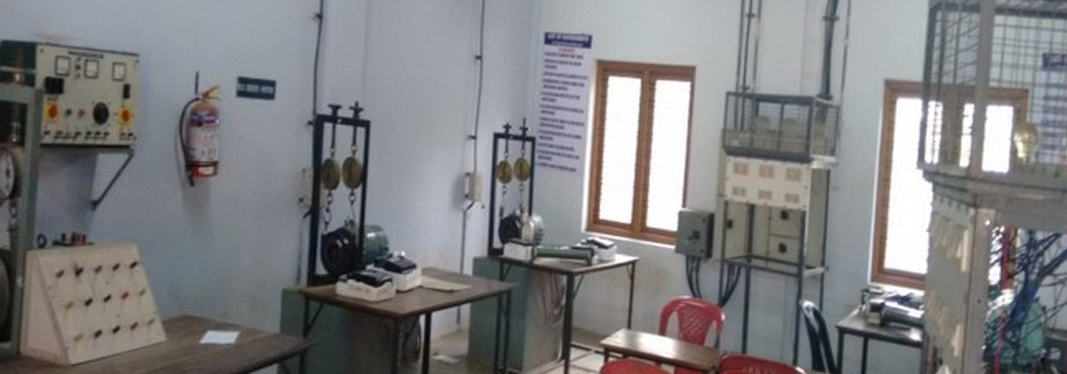
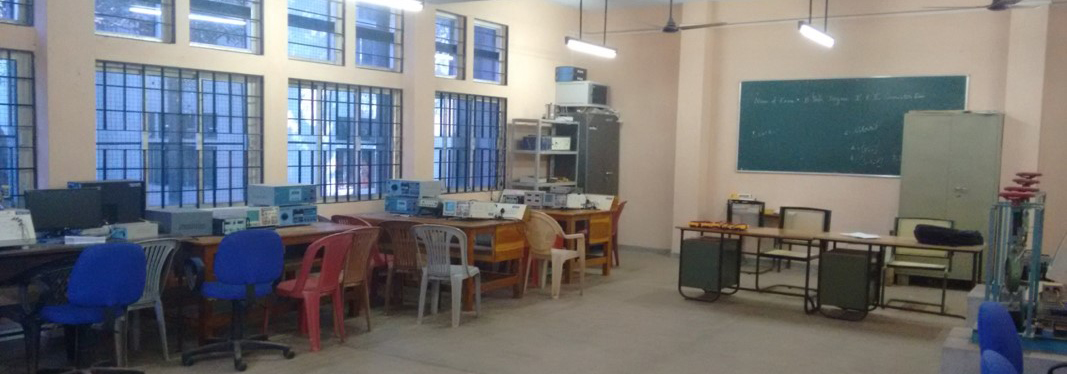
The Department of Electrical and Electronics Engineering in College of Engineering Perumon has been functioning from the year 2000, with an intake of 60. The department, with its well-qualified and experienced faculties and technical staffs, is committed to excel in Electrical Engineering through proper education and research.
Staff Empowerment
To be the innovative global leader in technical education and research by providing excellent education in Electrical & Electronics Engineering.
To produce high-quality professionals in Electrical & Electronics engineering who have serious concerns on engineering fundamentals, technological advancements, professional ethics and social value system.
Our graduates will have sound foundation in Electrical and Electronics Engineering to analyze, identify and solve real time problems in engineering. They will also have effective communicative skills to address social issues.
Our graduates will work efficiently in a team, possessing leadership skills along with professional ethical attitude, and will serve the society in an environment friendly way.
Our graduates will become entrepreneurs; they will contribute to research in multidisciplinary areas and will resort to lifelong learning for sustainable developments.
Engineering knowledge: Apply the knowledge of mathematics, science, engineering fundamentals, and an engineering specialization to the solution of complex engineering problems.
Problem analysis: Identify, formulate, review research literature, and analyze complex engineering problems reaching substantiated conclusions using first principles of mathematics, natural sciences, and engineering sciences.
Design/development of solutions: Design solutions for complex engineering problems and design system components or processes that meet the specified needs with appropriate consideration for the public health and safety, and the cultural, societal, and environmental considerations.
Conduct investigations of complex problems: Use research-based knowledge and research methods including design of experiments, analysis and interpretation of data, and synthesis of the information to provide valid conclusions.
Modern tool usage: Create, select, and apply appropriate techniques, resources, and modern engineering and IT tools including prediction and modelling to complex engineering activities with an understanding of the limitations.
The engineer and society: Apply reasoning informed by the contextual knowledge to assess societal, health, safety, legal and cultural issues and the consequent responsibilities relevant to the professional engineering practice.
Environment and sustainability: Understand the impact of the professional engineering solutions in societal and environmental contexts, and demonstrate the knowledge of, and need for sustainable development.
Ethics: Apply ethical principles and commit to professional ethics and responsibilities and norms of the engineering practice.
Individual and team work: Function effectively as an individual, and as a member or leader in diverse teams, and in multidisciplinary settings.
Communication: Communicate effectively on complex engineering activities with the engineering community and with society at large, such as, being able to comprehend and write effective reports and design documentation, make effective presentations, and give and receive clear instructions.
Project management and finance: Demonstrate knowledge and understanding of the engineering and management principles and apply these to one's own work, as a member and leader in a team, to manage projects and in multidisciplinary environments.
Life-long learning: Recognize the need for, and have the preparation and ability to engage in independent and life-long learning in the broadest context of technological change.
PSO 1 : Provide fundamental knowledge for the design and analysis of Electrical machines, Control systems, Power Electronic systems and Power systems.
PSO 2 : Exhibit technical capabilities to promote nonconventional energy systems and will be conversant in various technologies of e-mobility.
PSO 3 : Demonstrate proficiency in the use of modern engineering softwares, to design and analyze Electrical and Electronics systems.
Click here for Detailed Profile
| Sl No. | Name of Laboratory | Room No. | Faculty in Charge | Technical Staffs in Charge |
|---|---|---|---|---|
| 1 | E-MOBILITY LAB LAB. | F13 | Smt.SARITHA M | Sri.Abdul Latheef E |
| 2 | POWER SYSTEMS AND POWER ELECTRONICS SIMULATION LAB. | F4 | Smt.SARITHA M | Sri.Abdul Latheef E |
| 3 | MICROPROCESSORS AND MICROCONTROLLERS LAB | F4 | Smt.JASMI M S | Sri.Abdul Latheef E |
| 4 | POWER ELECRONICS LAB | F8 | Smt.VIJI CHANDRAN | Sri.sudheendran t.s |
| 5 | ANALOG ELECTRONICS LAB. | F8 | Smt.VIJI CHANDRAN | Sri.sudheendran t.s |
| 6 | CONTROL SYSTEMS LAB | F1 | Smt.jasna basheer. | Sri.sudheendran t.s |
| 7 | DIGITAL ELECTRONICS LAB | F1 | Sri.RAHUL CHARLES | Sri.Sudheendran t.s |
| 8 | PROJECT LAB. | F2 | Smt.EDWINA G RODRIGUES | Sri.abdul latheef |
| 9 | ELECTRICAL MACHINES LAB 1. | B1 | Smt.REKHA T | Sri.abdul latheef |
| 10 | ELECTRICAL MACHINES LAB 2. | B1 | Smt. Ajisha S | Sri.abdul latheef |
| 11 | CIRCUITS AND MEASURMENTS LAB. | B2 | Sri.THASREEF H R | Sri.vishnulal v.s |
| 12 | POWER SYSTEMS LAB. | B2 | Smt.SARITHA M | Sri.vishnulal v.s |
| 13 | ELECTRICAL ENGINEERING WORKSHOP. | A3 | Smt.JASMI M S | Sri.vishnulal v.s |
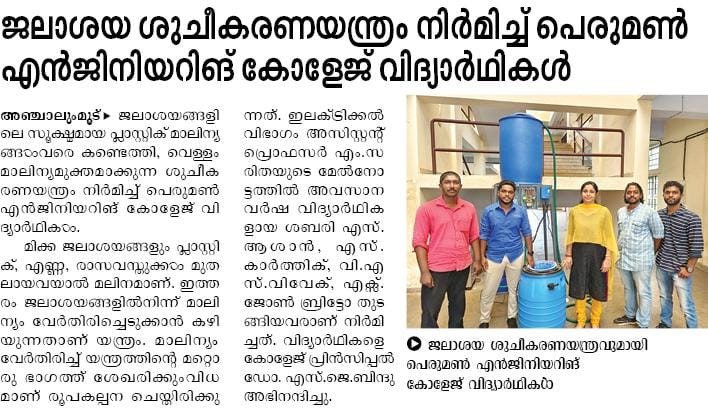
ACHIEVEMENTS 2021-22:
ACHIEVEMENTS 2020-21:
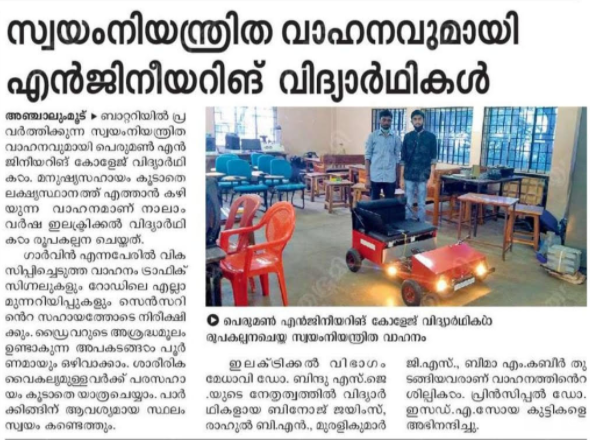
KSID INNOVATION AWARDS 2018: 3 projects from EEE Department received Kerala State Institute of Design –Innovation Awards 2018.
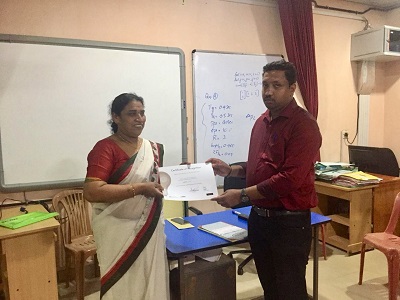
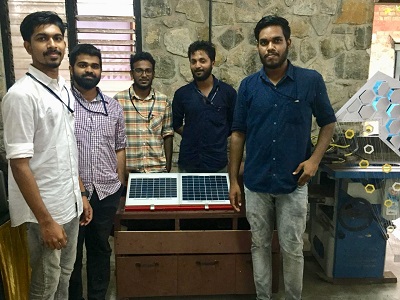
Three Intellectual product codes (IPS) are developed by department of Electrical and Electronics engineering in collaboration with C-DAC and these IPs are added to HSRPEC Library of CDAC.
IP titled MPPT_PO for the project ‘Efficient Drift Free Dual Boost Micro-Converter’ by Keerthana Nair S, Gopika S Parameswaran, Sajena BasheerA L, Shweta Mary Koshy, Ragikrishna R under the guidance of Dr. Bindu S J, HoD and associate Professor, EEE and Mrs. Edwina G Rodrigues, Asst. professor EEE.
IP titled BLDC_CTRLR for the project ‘A novel control strategy for energy efficient electric vehicle’ by Parvathy Krishnan S, Loyala Ann George, Rahana N R, Najiyath N, P M Athira under the guidance of Ms. Jasna Basheer, Asst. Professor EEE and Mr. Renjith G. Asst. professor EEE.
IP titled BLDC_CTRLR and MPPT_PO for the project ‘Single Stage PV Fed BLDC Motor for water Pumping Application’ by Lijo Julius, Muhammed Nafis N, Deepu Sam Alexander, Praveen J, Vyshak R under the guidance of Mr.Abilash r S, Asst. Professor EEE and Mr. Kannan S A. Asst. professor EEE. BEST PROJECT AWARD: Solar Powered Lawn Mover by Divya S, Gayathri M S, Sruthi Krishna R, Akhila B and Aswaraj S won third prize for the event project expo organised by College of Engineering Attingal. <
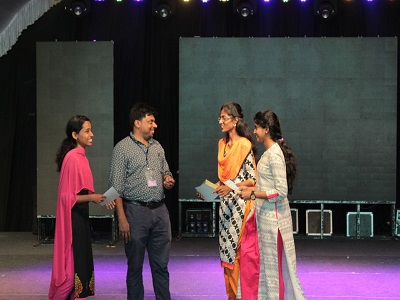
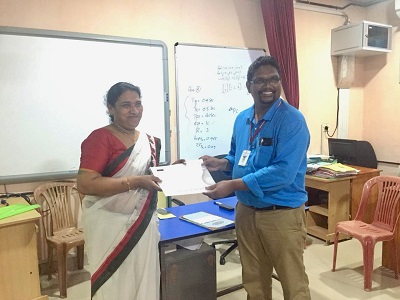
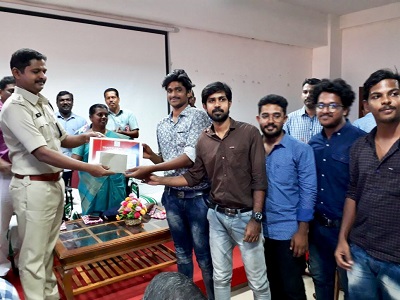
BEST PROJECT AWARD: Solar Powered Lawn Mover by Divya S, Gayathri M S, Sruthi Krishna R, Akhila B and Aswaraj S won third prize for the event project expo organised by College of Engineering Attingal.
JAGRATHA 2018: Final year students of Department of Electrical & Electronics Engineering participated in the project exhibition ‘JAGRATHA 2018’-Traffic Expo organised by Kerala Police from 02/02/2018 to 04/02/2018 at Bishop Jerome Institute, Kollam. Among the four groups, ‘Automatic collision avoidance system’ by Albin Koshy, Anand Santhosh, Ananthu V Krishnan, Sumesh S and Amal Mohan won third prize and the other three groups secured certificate of appreciation.
Rahul B N and Muralikumar G S of S3 EEE won second prize for Energy Quiz organised by KSEBA in the Kollam zone.
The students of our department have secured prestigious CUSAT ranks which is listed below:
| Sl No. | Year | Name | rank |
|---|---|---|---|
| 1 | 2004 | Anu G | I |
| 2 | Sumila Susan Thomas | II | |
| 3 | Sreejith S | III | |
| 4 | 2005 | Arun A | I |
| 5 | Aneeshya Raveendran | II | |
| 6 | Solymol K C | III | |
| 7 | 2006 | Dony C S | I |
| 8 | Arun Babu | II | |
| 9 | Aswathy Raj | III | |
| 10 | 2007 | Divya Vijay | I |
| 11 | 2008 | Lakshmi S | III |
| 12 | 2009 | Aneesh Kumar A S | III |
| 13 | 2011 | Jincy George | II |
| 14 | 2016 | Bilha Mathew | II |
| 15 | Greeshma G | III | |
| 16 | Gopika Krishnan P | V | |
| 17 | Mubarak M | VI | |
| 18 | 2017 | Kokila V | II |
| 19 | Meenakshi R Pillai | V | |
| 20 | Nishad N | VIII | |
| 21 | Sreelekshmi | IX | |
| 22 | Sreeya S | X | |
| 23 | Nikhitha Mariam Vinu | VIII | |
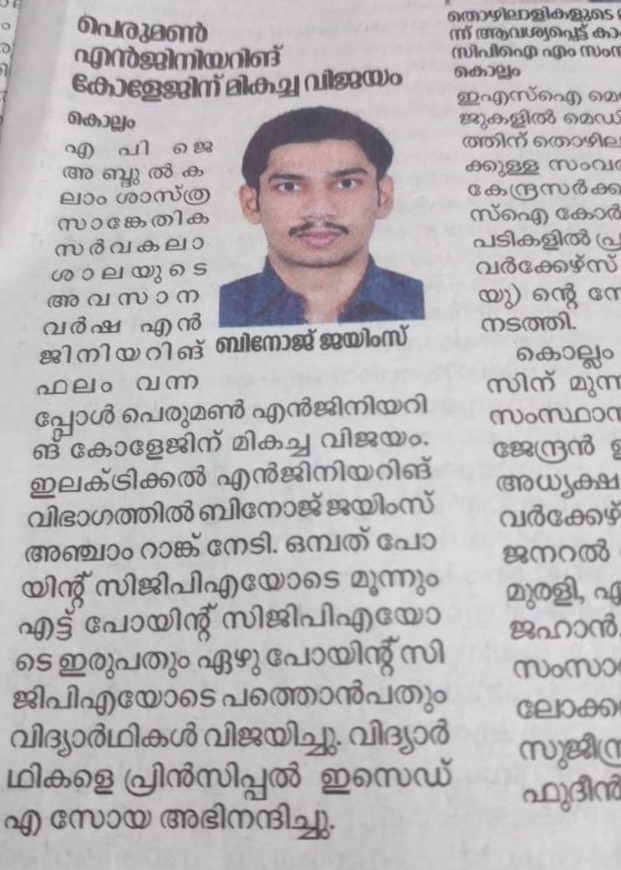
| 24 | 2020 | BINOJ JAMES | V(KTU) |
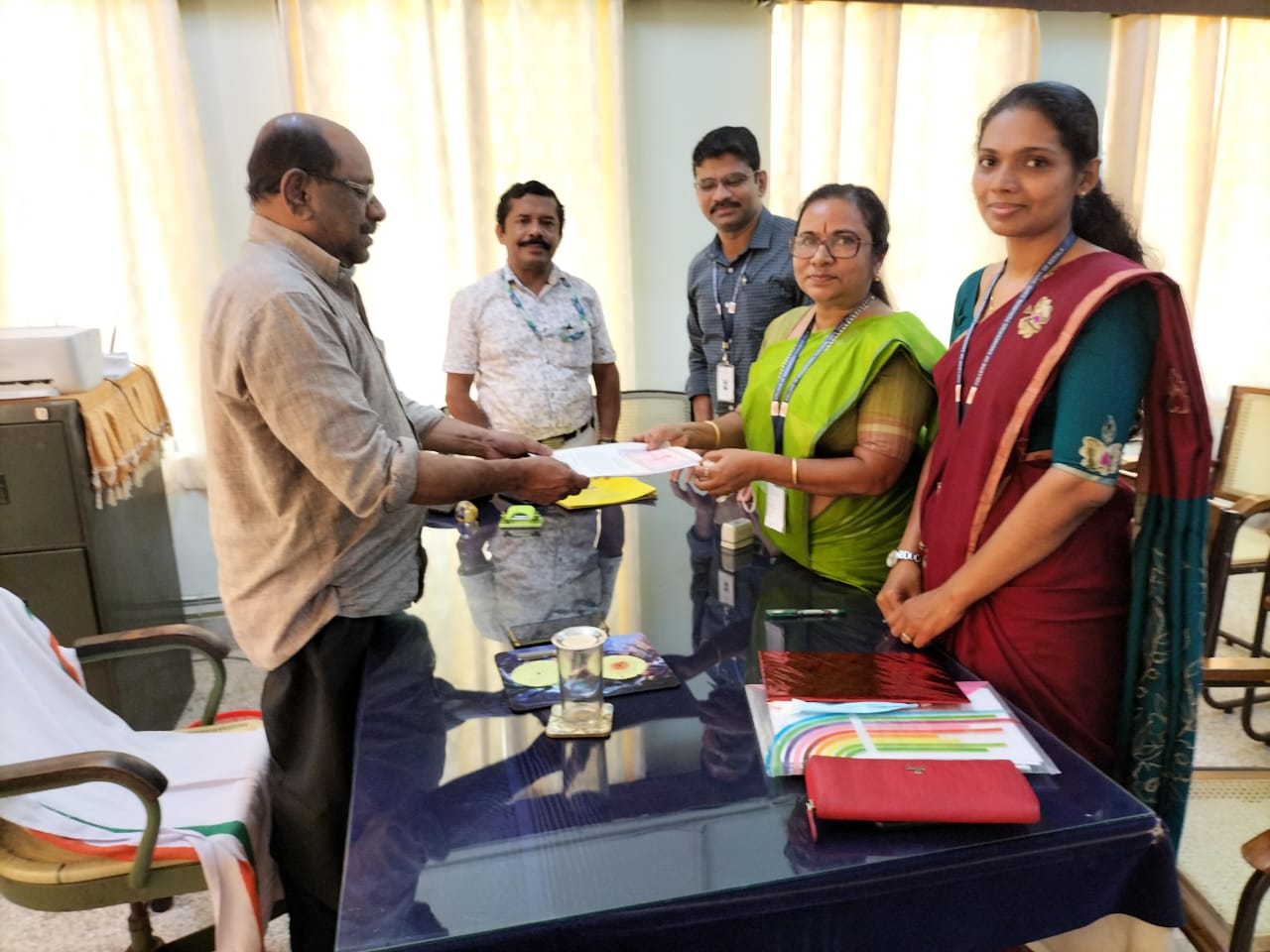
Renewal of MoU with KEL Kundara on 17/08/2022.
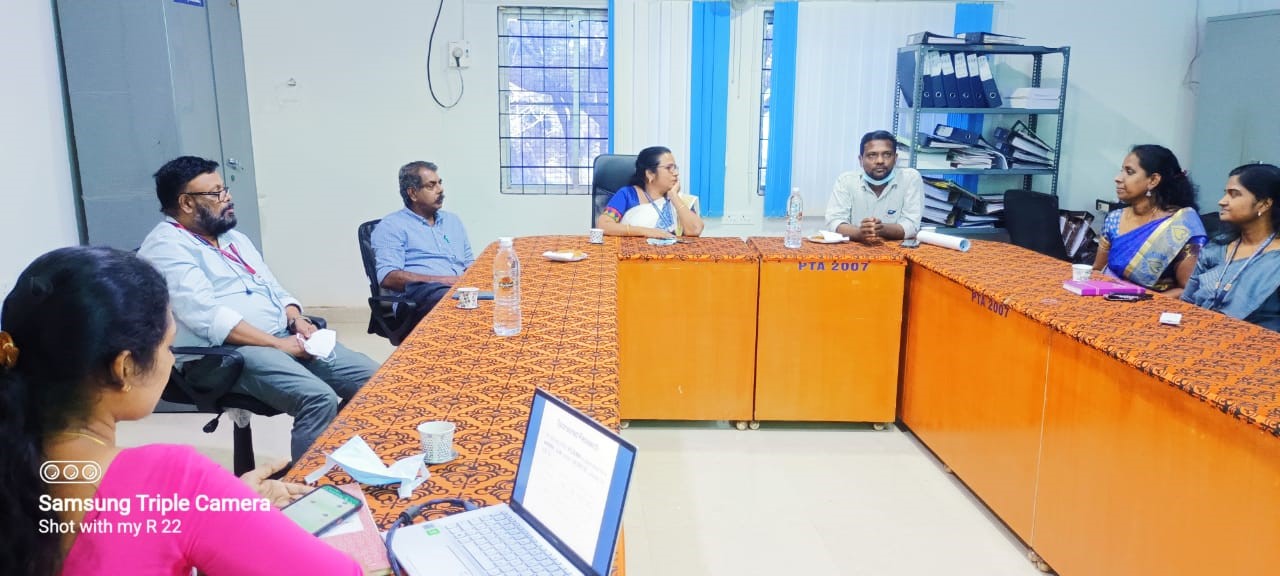
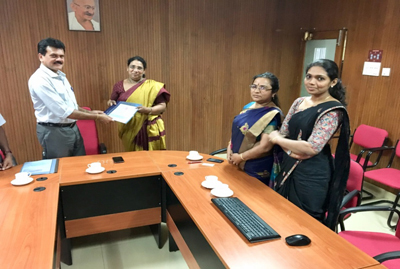
VIIIth Department advisory committee (DAC) meeting of Electrical and Electronics Engineering held on 12/08/2022.
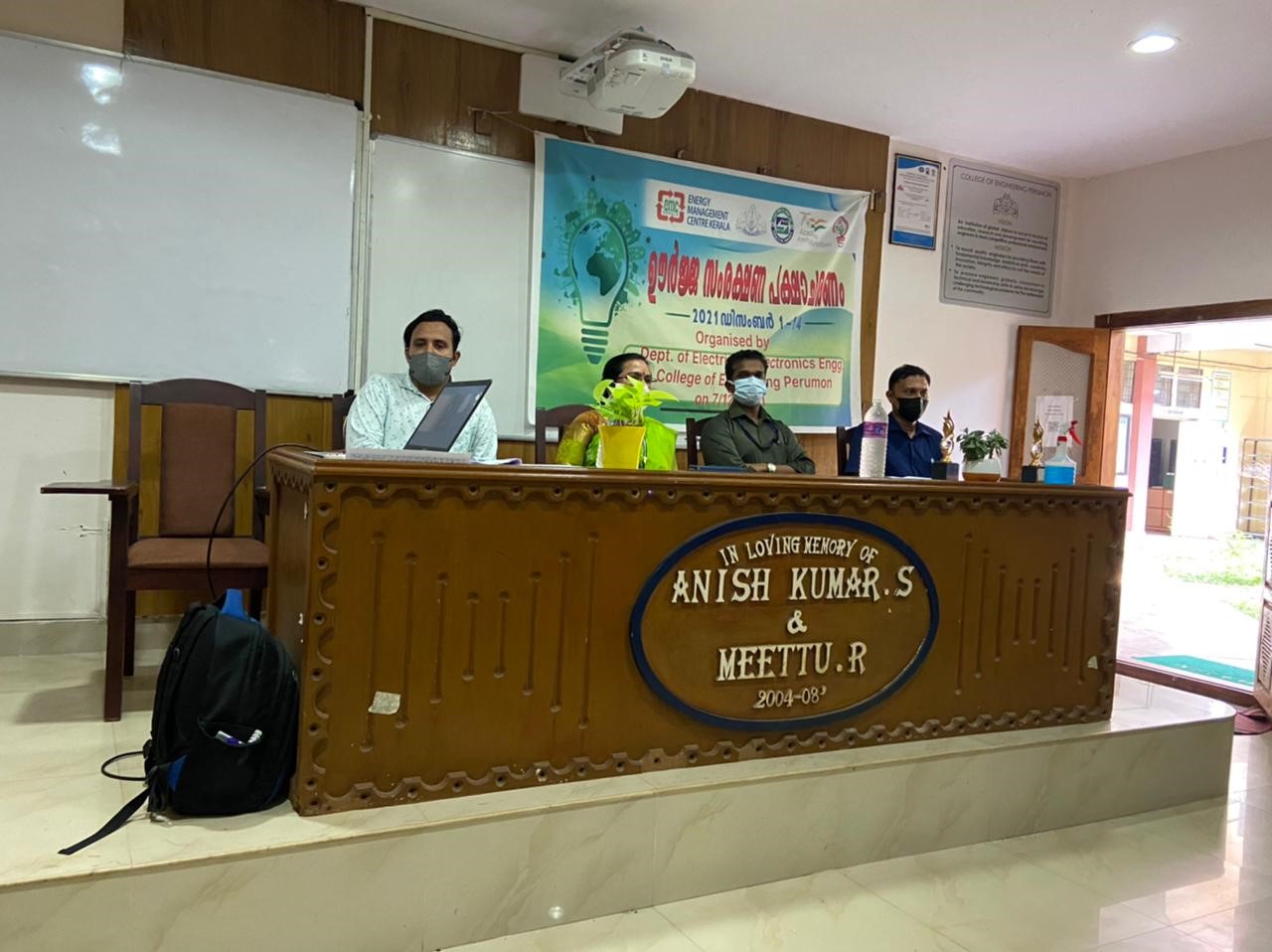
Energy Awareness Programme sponsored by Energy Management Centre (EMC), Kerala on 07-12-2021
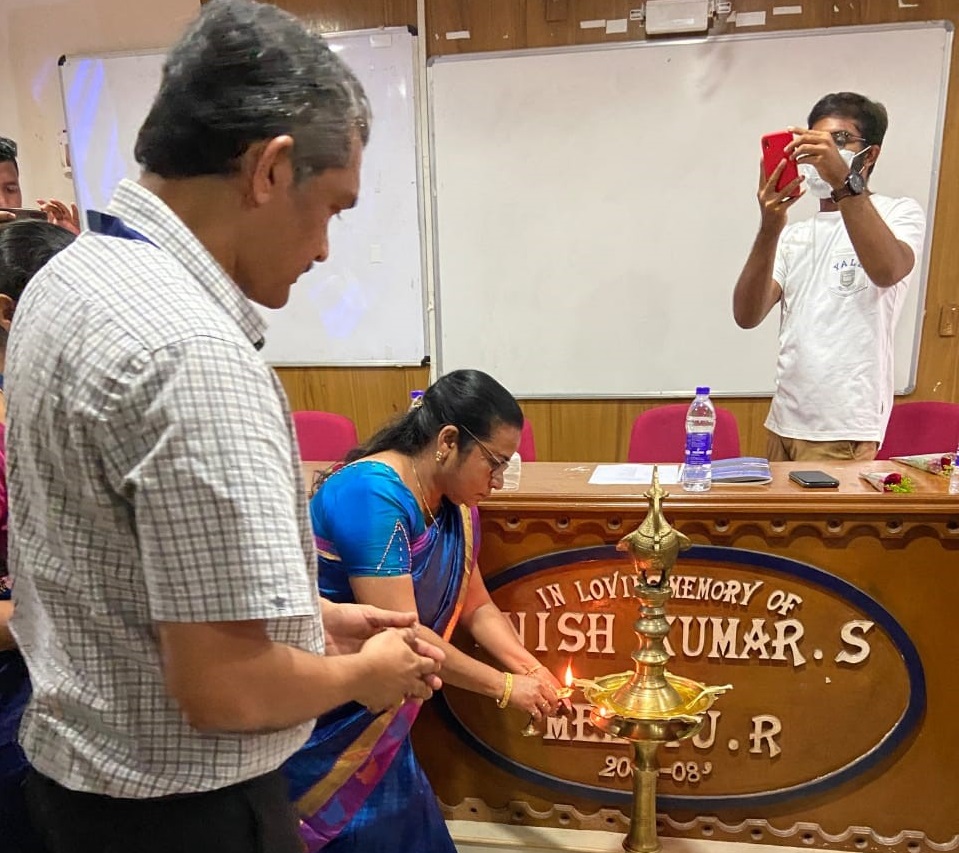
Vidyuth 4.0 in association with technical festival Advika 2022 inaugurated by Mr. Renji Chacko, Scientist G, Senior Director and Group Head, Power Electronics Group, CDAC, Trivandrum.
02 July 2022: Department of Electrical and Electronics Engineering organized a webinar on ‘Sensitization on Intellectual Property’ for the faculty members and final year students. The session was handled by Ms. Bessy Titus, Intellectual Property Manager at TIPS, a technology business incubator at Sree Chitra Tirunal Institute for Medical Science and Technology (SCTIMST).
10 June 2022: An expert session on ‘High Speed Reconfigurable Power Electronics Converters (HSRPEC) by Ajeesh A, Scientist E and Joint Director, Power Electronics Group, CDAC, Trivandrum is organised under Dyuthi, Student association of Department of Electrical and Electronics Engineering for S8 EEE students on 10/06/2022.
22 May 2022: A Hands on training on Arduino is organized for S2 EEE students on 22/05/2022 by Dyuthi, Student Association of Department of Electrical and Electronics Engineering. The session was handled by Mr. Suhail, Femto Lab Kollam.
21 May 2022: A workshop is organized on ‘Advanced Microcontrollers’ for S4 EEE students by Dyuthi, student association of Department of Electrical & Electronics Engineering on 21/05/2022. The session was handled by Mr. Suresh Haridas,Engineer at ICAR.
20 May 2022 to 22 May 2022: Vidyuth 4.0 in association with technical festival Advika 2022 was organized by Dyuthi, student association of Department of Electrical & Electronics Engineering and inaugurated by Mr. Renji Chacko, Scientist G, Senior Director and Group Head, Power Electronics Group, CDAC, Trivandrum. Exhibitions from ISRO, KEL, CDAC, KSEB and Project exhibitions were conducted.
20 May 2022 : Department of Electrical and Electronics Engineering released the of VIth volume of ‘Abstract Book’ on 20/05/2022 by Mr. Renji Chacko, Scientist G, Senior Director and Group Head, Power Electronics Group, CDAC, Trivandrum.
20 May 2022: A workshop is organized on ‘Fire and Safety’ for S2 EEE students by Dyuthi, student association of Department of Electrical & Electronics Engineering on 20/05/2022. The session was handled by Mr. Sajeev Kumar, Fire and Safety Officer, KMML, Chavara.
21 Jan 2021: An expert session on the topic ‘Basics of Robotics’ by Mr. Abhilash R.S., Asst Professor, CE Muttathara was organised for S3 EEE students on 21.01.2022.
17 Jan 2022 to 21 Jan 2022: ATAL online FDP on Research Trends in Design and Control of Electric Vehicles was conducted from 17-01-2022 to 21-01-2022. Around 117 participants were attended and the main resource persons were from IIST and IITs. Dr Amritha K, Associate Professor, Amrita ViswaVidhyaPeetham, Bangalore inaugurated FDP. The resource persons include Dr Rajeevan P P, Associate Professor, IIST, Trivandrum, Dr. Nikhil Sasidharan, Assistant Professor, NIT Calicut, Dr M P Selvan, Associate Professor NIT Trichy.
11 Jan 2021: An expert session on the topic ‘Design of Chebyshev and Butterworth Filters’ was taken by Mr. Bibu Thomas , Assistant Professor, CE Thalassery for S7 EEE students on 11.01.2022 under DYUTHI, student association of Electrical and Electronics Engineering.
07 Dec 2021: Department of Electrical & Electronics Engineering in association with Energy Management Centre, Trivandrum has conducted an ‘Energy Awareness Programme on 07-12-2021 for all staffs in our college. Around 100 staffs were attended the awareness programme. Mr. Dhanesh, Scientist from C-DAC, Trivandrum and Mr Azeem K- Senior Consultant, Alenso Energy Cochin handled the sessions.
4 Dec 2021: DYUTHI, the student association of Electrical and Electronics Engineering organized a One Day Workshop on “Programming using Arduino” for S5 EEE students.
02 Dec 2021 to 03 Dec 2021: A Workshop on “Arduino Programming” is orgnised for S5 EEE students from 02/12/2021 to 03/12/2021. The sessions were handled by Mr. Renjith G, Managing Director, FemmtoLab, Karikodu.and Mr Muhammed Suhail. P. K., Chief Operating Officer and Research Assistant, Femtolab, Karikodu. Kollam.
29 Nov 2021 to 30 Nov 2021: A Workshop on “Design Thinking” is organized for S7 EEE Students on 29/10/2021(FN and AN) and 30/10/2021 FN. The sessions were handled by Mr.Sabarinath, CEO, Out of Box and Mr. Arjun. C. P, Chief Operating Officer, Out of Box.
13 Nov 2021: A Workshop on “Carrier Opportunities in Electrical and Electronics Engineering” is organised for S7 EEE students on 13/11/2021 under IEDC. Resource Persons are Mr. Mridul. M. P. R&D Engineer, Mercedes Benz and Mr. Stellantis ( Formerly FCA), R& D Engineer.
19 Oct 2021: An expert session on the topic ‘Electromagnetics’ by Dr. B. Premlet, Professor, MES Institute of Technology and Management was conducted for S4 EEE students on 19.10.2021.
29 Sep 2021 to 30 Sep 2021: A Workshop on “Entrepreneur Knowledge in Solar Technology and Solar Installation” is organized under IEDC for S2 EEE students from 29/09/2021to 30/09/2021 2020. The session was handled by Mr. D. Kannan, Solar Energy Technology Trainer, Solar Tech Training Academy, Alappuzha.
13 Sep 2021 to 17 Sep 2021: Department of Electrical and Electronics Engineering has conducted five day online FDP on Robotics and Control: Theory and Practical Approaches from 13-09-2021 to 17-09-2021. Around 100 participants were attended and the main resource persons are Dr. M. Felix Orlando, Assistant Professor IIT Roorkee and Dr.Braneesh M Pillai from Mahidol University, Thailand.
08 March 2021 to 12 March 2021 : Department of Electrical And Electronics Engineering organized a Five-Day Online Faculty Development Program on “Modern Trends in Power Electronics” from 08-03-2021 to 12-03-2021. The programme was inaugurated by principal Dr. Z A ZOYA and the resource person were Dr.Kumaravel S., Assistant Professor, Dept. of Electrical Engineering, NIT Calicut, Dr. Jaison Mathew, Assistant Professor, Dept. Of EEE,GEC, Thrissur, Dr. Nikhil Sasidharan, Assistant Professor, Dept. of Electrical Engineering, NIT Calicut, Dr.Binoj Kumar A. C., Assistant Professor , Dept. Of EEE, GEC, Idukki, Dr. M. Nandakumar, Professor and HoD, Dept. of EEE, SCMS, Mrs.Bhavya Y. V., Scientist E/Joint Director, CDAC, Trivandrum, Dr.Biju K., Assistant professor and HoD, Dept. Of EEE, CE Munnar and Mr. Saravana Kumar A., Scientist E/Joint Director, CDAC, Trivandrum.
22 March 2021 and 27 March 2021: Department of Electrical And Electronics Engineering organized an International faculty development programme on ‘RESEARCH OPPORTUNITIES IN SMART GRID TECHNOLOGIES’ from 22nd to 27th MARCH, 2021. Inauguration was done by Dr. Mousa Marzband Senior lecturer, Department of Maths, Physics and Electrical Engineering Northumbria University, New castle, UK and the resource person were Dr.Shisaj P Simon, Associate Professor, Department of Electrical and Electronics Engg. NIT Trichy, Dr. Ankush Sharma, Associate Professor, Dept of Electrical Engineering, IIT Kanpur, Dr. Gopakumar P, Assistant Professor Department of Electrical Engineering, National Institute of Technology Calicut, Prof. Branesh M pillai Faculty Member (Foreign Expert), BART Lab, Mahidol University, Dr. Shreelakshmi M P Asst. Professor, Electrical Engineering NIT Calicut, Dr.Rajeev T, Professor, College of EngineeringTrivandrum, Mr.Ajith Gopi ,Heading Tech Consultancy in Solar Projects & Wind Energy Program at ANERT Vice-Chair IEEE-Power& Energy Society, Kerala, Dr. K.R Ashok Kumar, Asst Professor, Department of Electrical and Electronics Engg. National Institute of Technology Trichy
15 Jan 2020: Release of IVth volume of Book of Abstracts ‘ Abstract book 2020 by Dr. B. Permlet Former Professor and Head, Department of Physiscs, TKM College of Engineering Kollam
18 Dec 2019 to 22 Dec 2019: Department of Electrical and Electronics Engineering organised faculty development program on “Electric and Hybrid Vehicles” under the sponsorship of TEQIP II-Four Funds” from 18/12/2019 to 22/12/2019.
11 Dec 2019 to 13 Dec 2019:Department of Electrical and Electronics Engineering organised faculty development program on “Energy & Power Quality Audit methodologies” under the sponsorship of TEQIP II-Four Funds” from 11/12/2019 to 13/12/2019 and inaugurated by Shri. Suresh Babu BV, Accredited Energy Auditor, EMC Trivandrum. The sessions were handled by Shri. SubhashBabu BV, Energy Technologist, EMC, Shri. Johnson Daniel, Energy Technologist, EMC, ShriAneeshRajendran, Energy Technologist, EMC ,Shri. Dinesh kumar AN, Energy Technologist, EMC and Shri.Anith, Assistant Professor, College of Engineering Kidangoor.
14 Nov to 15Nov 2019; DYUTHI, the student association of Electrical and Electronics Engineering is organized a WORKSHOP ON PCB DESIGN AND FABRICATION for S3 EEE students on 14/11/2019 to 15/11/2019.
22 Nov to 23Nov 2019: A workshop on ‘Electrical system design using Autocad’ is organised for S7 EEE students by IIIC TEQIP II Four Funds.
4 Nov 2019:An expert session on the topic ‘Analog Electronic Circuits was conducted by Mr. Arun P L, Assistant Professor, CE Muttathara for S3 EEE students on 4/11/2019.
3 Sep 2019: Department of Electrical and Electronics Engineering organized a Project Expo underDyuthi, the student association of department of Electrical and Electronics Engineering organised a Project Expo on 03/09/2019. The function was inaugurated by Dr. Dinesh Pai, Professor, GEC Barton Hill. PMKVY awards were distributed in the same function by Mr. AjithGopi, Program Officer ANERT.The students and teachers from G H S SAshtamudi and G H S Panayil visited the Expo.
23 July 2019:Vth Department Advisory Committee (DAC) meeting was under TEQIP II Four funds and Dr. D.P Balachandran, Former Professor, College of Engineering Trivandrum, Mr. Senraj, manager, Design and Development, KEL, Kundara, Mr. Ajeesh A, Scientist/ Engineer, PEG, CDAC, Trivandrum, Mrs. Nirmala Issac, Assistant General Manager, switchgear design and production and Mr. Ameer A, KSEB, Kundara had atteded the meeting.
23 July 2019: Release of IIIrd volume of Project Book , ‘ NIRYUH 2017 'by Dr. D.P Balachandran, Former Professor, College of Engineering Trivandrum.
30 April 2019: Department of Electrical and Electronics Engineering released the of IIIrd volume of ‘Abstract Book’ on 30/04/2019by Dr. Najeeb, Director, SPFU.
10 April and 11 April 2019 : A workshop on ‘Modelling and Control of Power Electronic Converters’ is organised for S6 EEE students by IIIC TEQIP II Four Funds.
11 April 2019:Department of Electrical and Electronics Engineering organised an expert session on the topic ‘Logic Memories and VHDL Programming’ for S4 EEE students by Mr. Rahul Charles, Assistant Professor, College of Engineering Muttathara under TEQIP II Four funds.
26 Mar 2019:Department of Electrical and Electronics Engineering organised an expert session on the topic ‘Electromagnetics’ for S6 EEE students by Dr. Premlet, Former Professor, T K M College of Engineering under TEQIP II Four funds.
26 Mar 2019: Department of Electrical and Electronics Engineering released the VIIthvolume of Newsletter, DYUTHI 2018-19 by Mr. Ajeesh A, Scientist, PEG, CDAC Trivandrum.
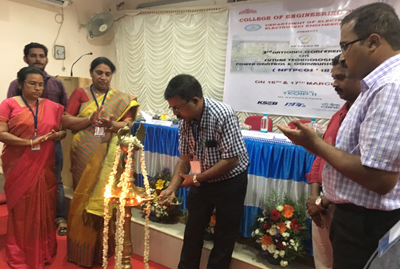
26 Mar to 27 Mar 2019: Department of Electrical and Electronics Engineering is organising Fourth National Conference on Future Technologies in Power, Control and Communication Systems’19 (NFTPCOS-’19) on 26/03/2019 and 27/03/2019. The function was inaugurated byDr. K Gopakumar, Professor, IISC Bangalore. The keynote address was on the topic ‘High resolution multilevel inverters for drives application’. A total 41 papers were presented and 31 papers are from outside the institution.
16 Jan to 18 Jan 2019: Department of Electrical and Electronics Engineering organised a KTU sponsored faculty development program on “Industrial Automation” from 16/01/2018 to 18/01/2019 and it was inaugurated by Er. Sreejith. T, LPSC, Valiyamala. The sessions were handled by Dr. Jisha V R, Associate Professor, CET, Dr. Imtiaz Ahammed, Professor, T K M College of Engineering, Resource Persons from Prolific Systems and Technologies Pvt. Ltd. and Mr. Joseph, CDAC. .
01 Nov to 05 Nov 2018:Department of Electrical and Electronics Engineering is organised a faculty development program on " Mi Power:-Applications in Power systems.
30 Oct 2018: Department of Electrical and Electronics Engineering released the 3rd volume of technical magazine, Rheos 2018 by Dr. L Vijayaraghavan, Professor, IIT Madras.
16 Oct 2018: A workshop on ‘Arduino Uno’ is organised for S1 EEE students by DYUTHI, the students association of Electrical and Electronics engineering.
23 Oct to 24 Oct 2018, DYUTHI, the student association of Electrical and Electronics Engineering is organizing a WORKSHOP ON PCB DESIGN AND FABRICATION for S3 EEE students.
12 Oct 2018 : A real time learning experience is organised for S3 EEE students on the topic ‘Familiarisation of Yard and Substation” by DYUTHI, the students association of Electrical and Electronics engineering.
07 Sep 2018: Department of Electrical and Electronics Engineering organised an expert session on the topic ‘Distributed generation and smart grid’ for S7 EEE students on by Dr. Dileep G, Assistant Professor, Madanapalle Institute of Technology and Science, Andhra Pradesh under TEQIP II Four funds.
23 July 2018: An MOU has been signed between Dept. of Electrical and Electronics Engineering and KEL, Kundarafor a period of three years to enhance the collaborative research works.
24 April 2018 to 30 April 2018: One week FDP on ‘High Speed Reconfigurable Power Electronic Controller’ was organized byDepartment of Electrical &Electronics Engineering and Sponsored by TEQIP II four funds and inaugurated by Dr. Dinesh Gopinath, HoD, GECIdukki. The sessions handled by Dr. Dinesh Gopinath, HoD, GEC Idukki,Mr. AjithGopi, Program Officer, ANERT, Mr. Ajeesh A, Senior Engineer, CDAC.etc.
20 April 2018: A hands on session on Energy auditing using power quality analyserorganized by Department of Electrical and Electronics Engineering and the session handled by Mr. JijoBalakrishnan, HoD, CE Muttathara. 18 April 2018: Expert Session on ‘Digital system memories’ was organized by Dyuthi, association of Electrical & Electronics Engineering students and session handled by Mr. Rahul Charles, Asst. Prof EEE, CE Muttathara.
12 April 2018: Release of IIndvolume of ‘Abstract Book’ byMr. Alex P V, Electrical Inspector,Kollam.
16 March 2018: : Third National conference on Future Technologies in Power, Control & Communication Systems(NFTPCOS’18) was organized by Dept.of Electrical &Electronics Engineering. It was inaugurated by Mr. Rajesh Joseph Abraham, Associate professor, Dept. of Avionics, Indian Institute of space science and technology and the conference proceeding was released by Dr. R. Sasikumar, Director, CAPE.
16 March 2018: Release of IInd volume of Project Book ‘ NIRYUH 2017by Mr. Dhanesh P R, Senior Engineer, CDAC.
14 March 2018: MOU has been signed between Dept. Electrical & Electronics Engineering and CDAC Trivandrum under IIIC for period of three years, as a part of Industry institute interaction.
16 Feb 2018 to 17 Feb 2018: Technical Expo: Vidyuth 3.0 in association with technical festivalAdvika 2018 was organized by Dyuthi, association of Electrical & Electronics Engineering students and inaugurated by Mr. José Paul, Group Director, LPSC,Valiamala.
16 Feb 2018:Release of VIth volume of Newsletter Dyuthi 2017organisedby student association of Electrical& Electronics Engineering by Mr. José Paul, Group Director, Cryogenics propulsion Stage Group, LPSC ,Valiamala.
12Feb 18 to 14 Feb 2018:Workshop on ‘ Arduino inIoT applications’ was organized by IIIC, TEQIP II and the session handled by Mr. Judson Anto, Mr. Unnikkuttan B, Project Engineers, DET softwares PVT LTD., Kozhikode. 06 Feb 2018- ArduinoWorld : Robotic Workshop on Arduino UNO for higher secondary students was organized by Dyuthi, association of Electrical & Electronics Engineering students..
25 Jan 2018: Expert session on ‘ HSRPEC’was organized by Dyuthi, association of Electrical & Electronics Engineering and the session handled by Ajeesh A , Staff Scientist C-DAC.
25 Jan2018:Expert session on ‘ Power Quality’ was organized by Dyuthi,Association of Electrical & Electronics Engineering and the session handled by Dr. D P Balachandran Former Professor CET.
25 Jan 2018:IV th Department Advisory Committee (DAC) meeting was under TEQIP II Four funds and Dr. D.P Balachandran, Former Professor, College of Engineering Trivandrum, Mr. Senraj, manager, Design and Development, KEL, Kundara, Mr. Ajeesh A, Staff Scientist/ Engineer, CDAC, Trivandrum, Mrs. NirmalaIssac, Assistant General Manager, switchgear design and production had atteded the meeting..
05 Oct 2017- Expert lecture on ‘Latex Software’ was organized by Dyuthi, association of Electrical & Electronics Engineering for S7 EEE students and the session handled by Mr. NebuPulikkal,Software Engineer Opzet Solutions,Eranakulam.
30 March 2017-Expert Lecture on Induction Machine was organized byDept.of Electrical &Electronics Engineering for S6 EEE students.
23,24 March 2017-A national technical EXPO,VIDYUTH 2.0 was organized by Dyuthi, student association of Electrical & Electronics Engineering. Industries like KEL, ANERT, United ElectricalLTD.,Travancore Medical College,andMedicity gave an exposure to the students to familiarize the industries.
23, 24 March 2017: SecondNational conference on Future Technologies in Power, Control & Communication Systems(NFTPCOS’17) was organized byDept.of Electrical &Electronics Engineering under TEQIP II. More about, the conference was inaugurated by Dr.Mahesh Kumar,Professor,IIT Madras.The program includes invited talk by eminent experts in the relative and 50 papers presented by the researchers.
23 March 2017: Hand over of Solar Tunnel Dryer, the final year project of (2012-16) batch students to Agricultural Technology Management Agency (ATMA).
13, 14 March 2017: National Research Colloquium on ‘Recent Advancements in Electrical Engineering’ was conducted byDept.of Electrical &Electronics Engineering under TEQIP II.More about(Four tracks of research colloquium were handled by Dr.B.G Fernandes,Professor&HOD IIT Bombay, Dr.Kishore Chatterjee,Professor IIT Bombay, Dr.Praveen Kumar IIT Guwahatti&Mr.Dhanesh P.R, Scientist C-DAC.)
| Sl No. | Title of the Project Proposal | Name of the Principal Investigator | Name of Funding Agency | Amount Sanctioned | Duration |
|---|---|---|---|---|---|
|
. |
MODROB on e-mobility |
Dr.Bindu S J |
AICTE |
Rs.19,23,000/- |
2 Years |
|
. |
PV based open well submersible sensor less BLDC motor drive |
Mrs. Jasna Basheer |
CERD |
Rs.1,16,000/- |
3 years |
|
. |
An equipment for sedating patients in dental surgery for AIIMS Delhi |
Dr.Bindu S J |
AIIMS Delhi |
Rs.50,000/- |
1 year |
|
. |
Water Cleaning vaccum pump and Quality Monitoring system |
Mrs.Saritha M |
CERD |
Rs.24,000/- |
1 year |
|
. |
Wireless Charging Solar Road for EVs |
Mrs.Viji Chandran |
TEQIP |
Rs.5000/- |
1 year |
|
. |
IoT based portable Ventilator |
Mrs.Edwina G Rodrigues |
TEQIP |
Rs.5000/- |
1 year |
|
. |
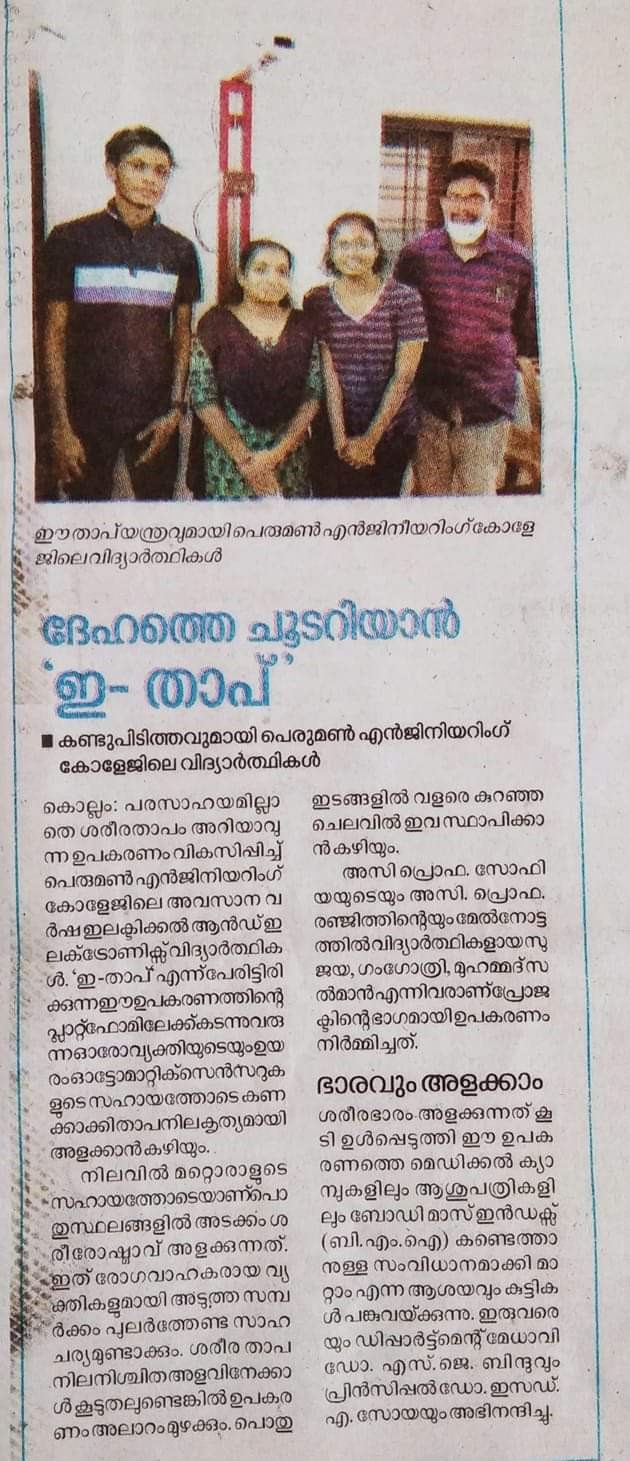
E-THAAP: Automatic body temperature sensing device |
Mrs.Jasmi M S |
TEQIP |
Rs.5000/- |
1 year |
|
. |
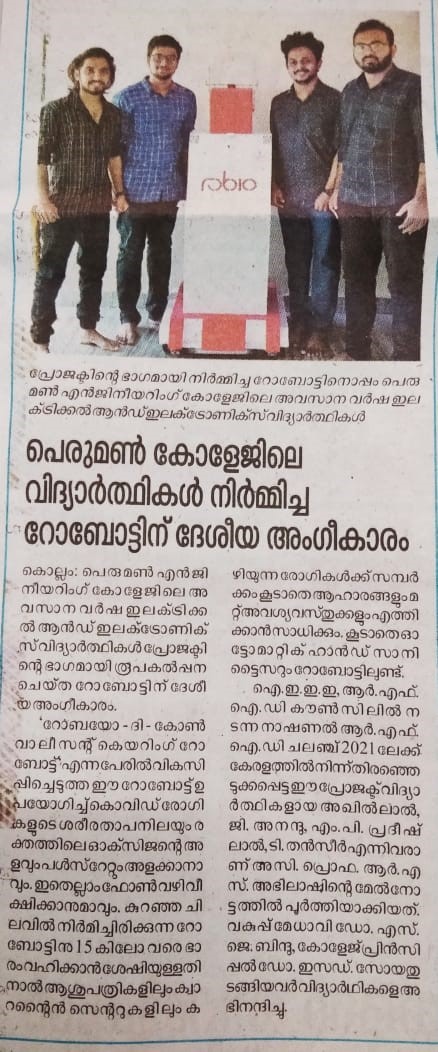
Robio-A convalescent robot |
Mrs. Saritha M |
TEQIP |
Rs.5000/- |
1 year |
|
. |
Solar Powered Aqua Ro-boat |
Mrs. Ajisha |
CERD |
Rs.25,500/- |
3 years |
|
. |
FFR based SAMSYS |
Mrs. Jasna Basheer |
KSCSTE |
Rs.10,000/- |
1 year |
|
. |
UVOS-Ultra Violet ozone based sterilizer |
Mr. Abilash R S |
TEQIP |
Rs.5,000/- |
1 year |
|
. |
GARVIN-GPS and real time computer vision based Intelligent Navigation system for Electric Vehicles |
Dr. Bindu S J |
TEQIP |
Rs.5,000/- |
1 year |
|
. |
Solar Powered Aqua Trams |
Mr. Abilash R S |
KSCSTE |
Rs.8,000/- |
1 year |
|
. |
Smart Energy Management |
Dr. Bindu S J |
KSCSTE |
Rs.7,000/- |
1 year |
|
. |
IoT Based Agrometer |
Mrs.Edwina G Rodrigues |
KSCSTE |
Rs.8,000/- |
1 year |
|
. |
Smart Health Monitoring Wheel Chair Using IoT Applications |
Mrs. Sofiya A |
KSCSTE |
Rs.8,000/- |
1 year |
|
. |
VI-VE: A Safety Vehicle Control System |
Dr. Bindu S J |
INNOVATE-KSCSTE |
Rs.15000/- |
1 year |
|
. |
Solar Powered LVDC Nanogrid |
Mrs.Edwina G Rodrigues |
TEQIP II |
Rs.5000/- |
1 year |
|
. |
Design and implementation of solar powered BLDC pump for water purification |
Mrs. Rekha T |
TEQIP II |
Rs.5000/- |
1 year |
|
. |
Automatic line power control using power line communication & Hall effect Sensor |
Mrs. Sofiya A |
TEQIP II |
Rs. 48,508/- |
1 year |
|
. |
Smart vehicle with sign board adaptive speed governing system |
Mrs. Rekha T |
TEQIP II |
Rs. 58,586/- |
1 year |
|
. |
Li-Fi communication system with Industrial Automation and Biomedical applications |
Dr. Bindu S J |
TEQIP II |
Rs. 34,450/- |
1 year |
|
. |
Optimizing energy savings using battery less PV Harvesting system with grid backup and real time Solar Tracking” |
Mrs. Deepa M U |
TEQIP II |
Rs. 31, 826 |
1 year |
|
. |
Fault detection using pole Climbing Robot |
Mrs. Saritha M |
TEQIP II |
Rs.40,337/- |
1 year |
|
. |
“Direct AC-AC Resonant Boost converter “ |
Mrs.Sofiya A |
TEQIP II |
Rs.28,791/- |
1 year |
|
. |
“Automatic Monitoring and control of interleaved flyback converter “ |
Mrs.Viji Chandran |
TEQIP II |
Rs.36,276/- |
1 year |
|
. |
“ Grid connected by Micro Converter “ |
Mr.Jijo Balakrishnan |
TEQIP II |
Rs.44,839/- |
1 year |
|
. |
“ PFC converter for LED “ |
Mr.Rajesh A.V |
TEQIP II |
Rs.45,090/- |
1 year |
|
. |
“ Design and fabrication of solar Boat “ |
Mrs. Edwina G Rodrigues |
TEQIP II |
Rs.92,327/- |
1 year |
|
. |
“ Bridgeless power factor connected converter fed induction motor” |
Mrs.Sofiya A |
TEQIP II |
Rs.42,991/- |
1 year |
|
. |
“Emergency assisting autonomous robot using GPS “ |
Mrs. Edwina G Rodrigues |
TEQIP II |
Rs.42,463/- |
1 year |
|
. |
“Reduction of Harmonic Distortion in BLDC drive using BL-Buck Boost converter” |
Mr.Rajesh A V |
TEQIP II |
Rs.26,622/- |
1 year |
|
. |
"Advanced multifunction charge controller for vehicle “ |
Dr. Bindu S.J |
TEQIP II |
Rs.27,894/- |
1 year |
|
. |
“Smart solar Tunnel dryer” |
Dr. Bindu S.J |
TEQIP II |
Rs 74,541/- |
1 year |
|
. |
“Wireless Signalling in Railways” |
Dr. Bindu S.J |
CERD |
Rs 23,000/- |
1 year |
|
. |
Blind Assisting Robot |
Mrs.Rekha T |
INNOVATE Scheme of KCSTE |
10000 |
1 year |
|
. |
Integrated Smart Bin |
Mrs.Sofia A |
INNOVATE Scheme of KCSTE |
20000 |
1 year |
|
. |
Automatic Ration Vending Machine |
Mrs.Aswathy B |
INNOVATE Scheme of KCSTE |
15000 |
1 year |
|
. |
A Novel Control Strategy For Energy Efficient Hybrid Electric Vehicle |
Ms. Jasna Basheer |
Energy Management Centre |
4000 |
1 year |
|
. |
An Efficient Drift Free MPPT for a Dual Boost Microinverter |
Mrs Edwina G Rodrigues |
Energy Management Centre |
3800 |
1 year |
|
. |
PLC based Automatic Draw Bridge |
Mr.Arun M S |
TEQIP-II |
5000 |
1 year |
|
. |
Simple Stage PV fed BLDC Motor for Water Pumping Application |
Mrs.Abilash R S |
TEQIP-II |
5000 |
1 year |
| Sl No. | Year | Name of Firm | Details of Work | Amount |
|---|
Dyuthi, the student association of department of Electrical and Electronics Engineering was established in the year 2005. The goal is to organize social and professional activities which strengthen and enrich the community within the department, and to engage various research activities within the department.The Association seeks to encourage team work and the spirit of self-reliance among its student members.Dyuthi conducts various workshops,technical talks by eminent personalities, technical expo, short term courses, exhibitions etc.The annual publications include Newsletter DYUTHI, Technical Magazine RHEOS, Journal, Project book NIRYUH and abstract book.
OBJECTIVES
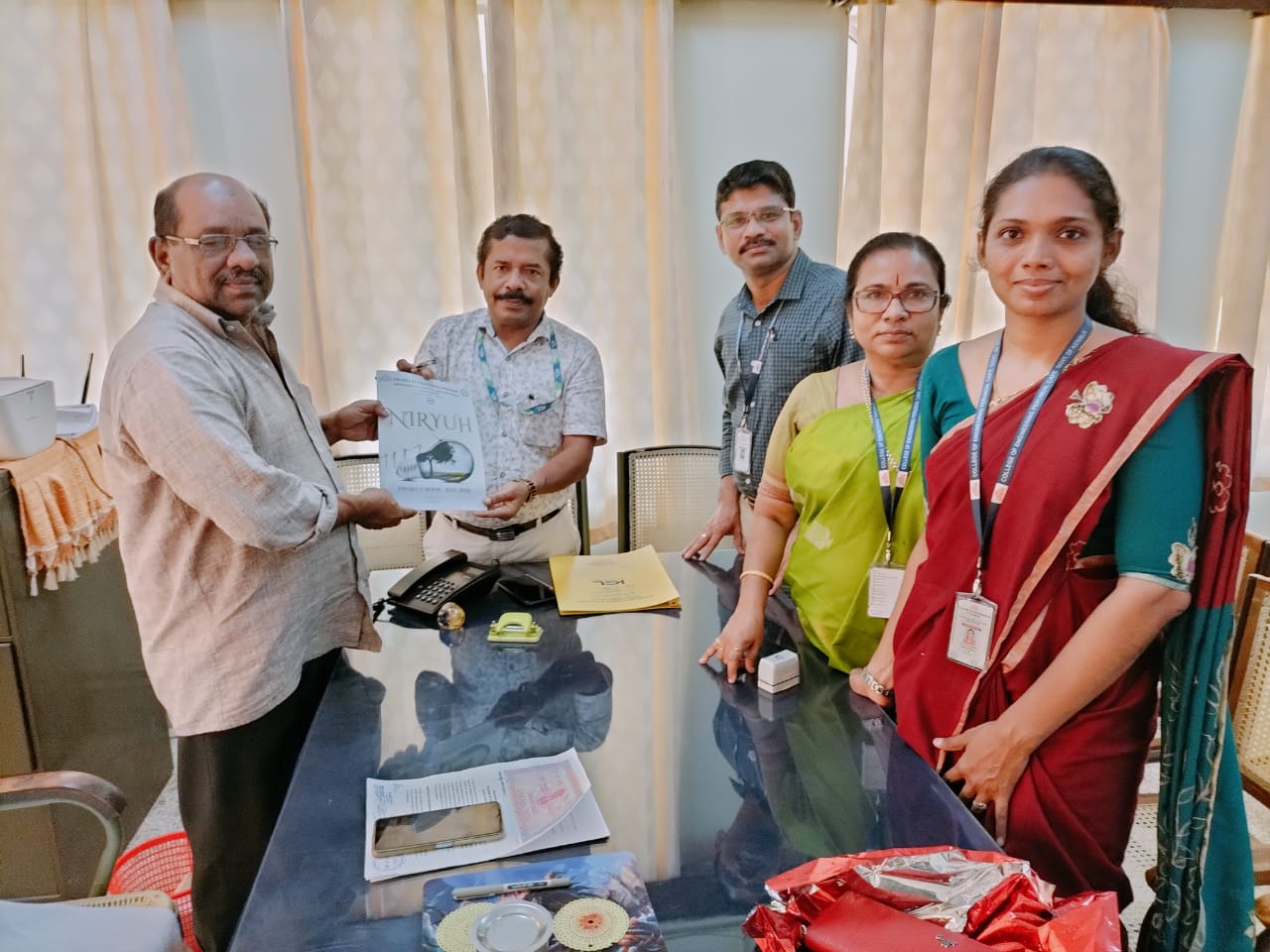
Release of VIth volume of Project book 'Niryuh 2022' by Baiju K S, General Manager KEL Kundara.
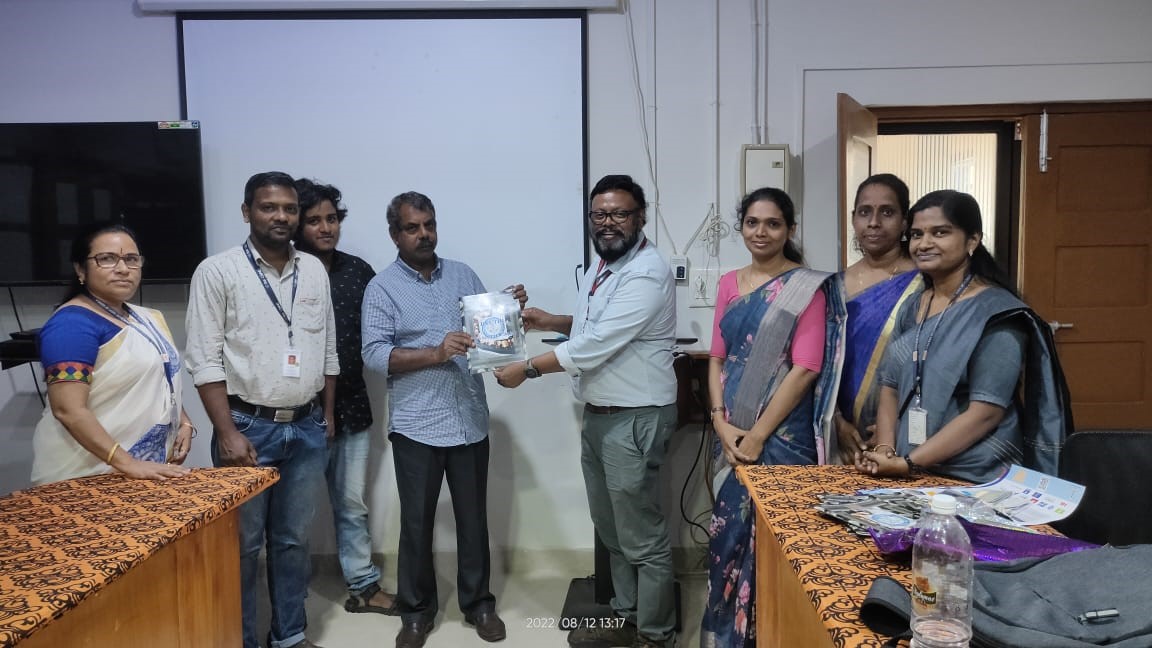
Releasing Newsletter 2021, Volume IX, Issue 1 by Mr. Ajith Gopi, Joint Chief Technical Manager, ANERT on 12/08/2022
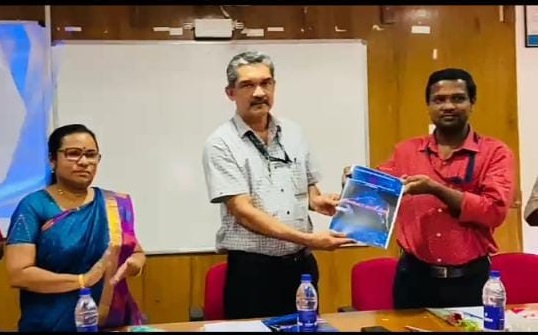
Releasing of VIth volume of ‘Abstract Book’ by Mr. Renji Chacko, Scientist G, Senior Director and Group Head, Power Electronics Group, CDAC, Trivandrum on 20/05/2022.
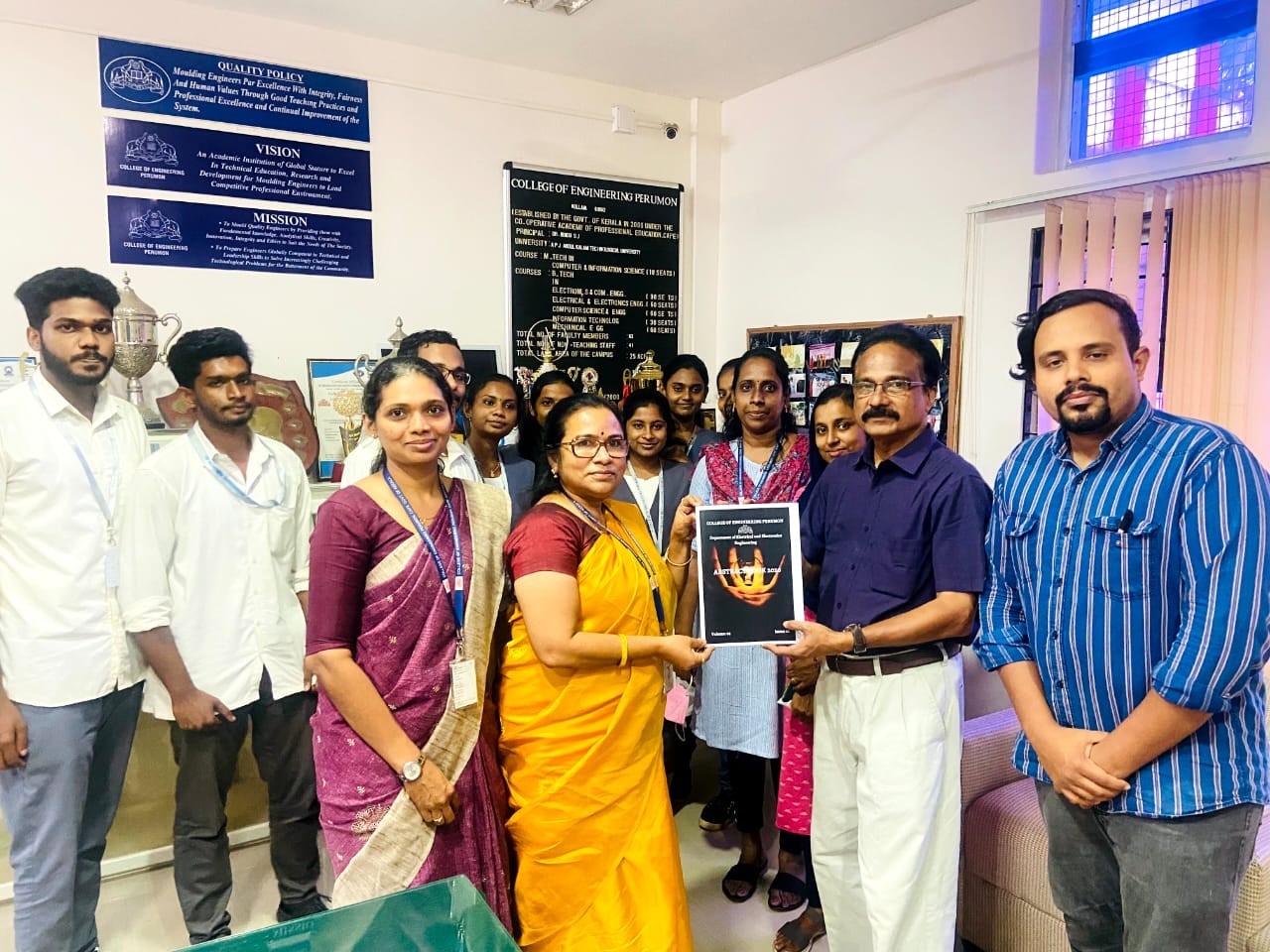
Releasing of IVth volume of ‘Abstract Book ’ by Dr. B. Permlet Former Professor and Head, Department of Physiscs, TKM College of Engineering Kollam on 15/01/2020.
ANNUAL PUBLICATIONS
| Sl No | Publication | Volume | Released by |
|---|---|---|---|
* |
Abstract book 2022 | Volume VI | Mr. Renji Chacko, Scientist G, Senior Director and Group Head, Power Electronics Group, CDAC, Trivandrum on 20/05/2022. |
* |
Abstract book 2020 | Volume IV | Dr. B. Permlet Former Professor and Head, Department of Physiscs, TKM College of Engineering Kollam on 15/01/2020 |
* |
Project Book, Niryuh 2019 | Volume III | Dr. D.P Balachandran, Former Professor, College of Engineering Trivandrum on 23/07/2019 |
* |
Abstract book 2019 | Volume III | Dr. Najeeb, Director, SPFU on 30/04/2019 |
* |
Newsletter 2018-19 | Volume VII | Dr. K Gopakumar, Professor, IISC Bangalore and Mr. Ajeesh A, Scientist, PEG, CDAC Trivandrum on 26/03/2019 |
* |
Technical Magazine Rheos 2018 | Volume III | Dr. L Vijayaraghavan, Professor, IIT Madras on 30/10/2018. |
* |
Project Book, Niryuh 2018 | Volume II | Mr. Dhanesh P R, Senior Engineer, CDAC on 16/03/2018 |
* |
Abstract book 2018 | Volume II | Mr. Alex P V, Electrical Inspector, Kollam on 12/04/2018 |
* |
Newsletter 2017 | Volume VI | Mr. José Paul, Group Director, Cryogenics propulsion Stage Group, LPSC ,Valiamala on 16/02/2018. |
* |
Project Book, 2017 | Volume I | Dr. Jayakumar, SPFU Director, TEQIP on 30/03/2017 |
* |
Abstract book 2017 | Volume I | Dr. L Vijayaraghavan, Professor, IIT Madras on 30/03/2017 |
* |
Newsletter 2017 | Volume V | Dr. B G Fernandes, Professor and head, Department of Electrical engineering, IIT Bombay on 13/03/2017. |
* |
Newsletter 2016 | Volume IV | Dr. K P ParameswaranPillai on 16/12/2015. |
* |
Technical Magazine Rheos 2018 | Volume II | Dr. G Narayanan, Senior Scientist, LPSC on 03/02/2016 |
* |
Technical Journal: Journal of Electrical and Electronics Engineering 2015 | Volume II | Mr. Cizil C, Scientist, ISRO on 02/03/2016 |
* |
Newsletter 2015 | Volume III | Dr. L Vijayaraghavan, Profesor, IIT Madras on 26/12/2014 |
Activities
10 June 2022: An expert session on ‘High Speed Reconfigurable Power Electronics Converters (HSRPEC) by Ajeesh A, Scientist E and Joint Director, Power Electronics Group, CDAC, Trivandrum is organised under Dyuthi, Student association of Department of Electrical and Electronics Engineering for S8 EEE students on 10/06/2022.<
22 May 2022: A Hands on training on Arduino is organized for S2 EEE students on 22/05/2022 by Dyuthi, Student Association of Department of Electrical and Electronics Engineering. The session was handled by Mr. Suhail, Femto Lab Kollam.
21 May 2022: A workshop is organized on ‘Advanced Microcontrollers’ for S4 EEE students by Dyuthi, student association of Department of Electrical & Electronics Engineering on 21/05/2022. The session was handled by Mr. Suresh Haridas,Engineer at ICAR.
20 May 2022 to 22 May 2022: Vidyuth 4.0 in association with technical festival Advika 2022 was organized by Dyuthi, student association of Department of Electrical & Electronics Engineering and inaugurated by Mr. Renji Chacko, Scientist G, Senior Director and Group Head, Power Electronics Group, CDAC, Trivandrum. Exhibitions from ISRO, KEL, CDAC, KSEB and Project exhibitions were conducted.
20 May 2022 : Department of Electrical and Electronics Engineering released the of VIth volume of ‘Abstract Book’ on 20/05/2022 by Mr. Renji Chacko, Scientist G, Senior Director and Group Head, Power Electronics Group, CDAC, Trivandrum.
20 May 2022: A workshop is organized on ‘Fire and Safety’ for S2 EEE students by Dyuthi, student association of Department of Electrical & Electronics Engineering on 20/05/2022. The session was handled by Mr. Sajeev Kumar, Fire and Safety Officer, KMML, Chavara.
4 Dec 2021: DYUTHI, the student association of Electrical and Electronics Engineering organized a One Day Workshop on “Programming using Arduino” for S5 EEE students.
09 September 2021 to 10 September 2021: DYUTHI, the student association of Electrical and Electronics Engineering organized a WORKSHOP ON PCB DESIGN AND FABRICATION for S3 EEE students from 09/09/2021 to 10/09/2021.
15 Jan 2020: Release of IVth volume of Book of Abstracts ‘ Abstract book 2020 by Dr. B. Permlet Former Professor and Head, Department of Physiscs, TKM College of Engineering Kollam.
14 Nov to 15Nov 2019: DYUTHI, the student association of Electrical and Electronics Engineering is organized a WORKSHOP ON PCB DESIGN AND FABRICATION for S3 EEE students on 14/11/2019 to 15/11/2019.
3 Sep 2019: Department of Electrical and Electronics Engineering organized a Project Expo under Dyuthi, the student association of department of Electrical and Electronics Engineering organised a Project Expo on 03/09/2019. The function was inaugurated by Dr. Dinesh Pai, Professor, GEC Barton Hill. PMKVY awards were distributed in the same function by Mr. AjithGopi, Program Officer ANERT. The students and teachers from G H S SAshtamudi and G H S Panayil visited the expo.
3 Sep 2019:An expert session on the topic ‘Power generation, transmission and protection was conducted by Mr. AjithGopi, Program Officer ANERT for S5EEE students on 03/09/2019.
3 Sep 2019:An expert session on the topic ‘Digital signal processing’ was conducted by Dr. Dinesh Pai, Professor, GEC Barton Hill for S7 EEE students on 03/09/2019.
23 July 2019: Release of IIIrd volume of Project Book ‘ NIRYUH 2017by Dr. D.P Balachandran, Former Professor, College of Engineering Trivandrum.
30 April 2019 :Department of Electrical and Electronics Engineering released the of IIIrd volume of ‘Abstract Book’ on 30/04/2019 by Dr. Najeeb, Director, SPFU.
26 Mar 2019: Department of Electrical and Electronics Engineering released the VIIth volume of Newsletter, DYUTHI 2018-19 by Mr. Ajeesh A, Scientist, PEG, CDAC Trivandrum.
30 Oct 2018: Department of Electrical and Electronics Engineering released the 3rd volume of technical magazine, Rheos 2018 by Dr. L Vijayaraghavan, Professor, IIT Madras.
16 Oct 2018: A workshop on ‘Arduino Uno’ is organised for S1 EEE students by DYUTHI, the students association of Electrical and Electronics engineering.
23 Oct to 24 Oct 2018:, DYUTHI, the student association of Electrical and Electronics Engineering is organizing a WORKSHOP ON PCB DESIGN AND FABRICATION for S3 EEE students.
12 Oct 2018 : A real time learning experience is organised for S3 EEE students on the topic ‘Familiarisation of Yard and Substation” by DYUTHI, the students association of Electrical and Electronics engineering.
18 April 2018: Expert Session on ‘Digital system memories’ was organized by Dyuthi, association of Electrical & Electronics Engineering students and session handled by Mr. Rahul Charles, Asst. Prof EEE, CE Muttathara.
12 April 2018: Release of IIndvolume of ‘Abstract Book’ by Mr. Alex P V, Electrical Inspector, Kollam.
16 March 2018: Release of IInd volume of Project Book ‘ NIRYUH 2017 by Mr. Dhanesh P R, Senior Engineer, CDAC.
16 Feb 2018 to 17 Feb 2018:Vidyuth 3.0 in association with technical festivalAdvika 2018 was organized by Dyuthi, association of Electrical & Electronics Engineering students and inaugurated by Mr. José Paul, Group Director, LPSC, Valiamala.
16 Feb 2018:Release of VIth volume of Newsletter Dyuthi 2017 organisedby student association of Electrical & Electronics Engineering by Mr. José Paul, Group Director, Cryogenics propulsion Stage Group, LPSC ,Valiamala.
06 Feb 2018- ArduinoWorld : Robotic Workshop on Arduino UNO for higher secondary students was organized by Dyuthi, association of Electrical & Electronics Engineering students.
25 Jan 2018: Expert session on ‘ HSRPEC’ was organized by Dyuthi, association of Electrical & Electronics Engineering and the session handled by Ajeesh A , Staff Scientist C-DAC.
25 Jan2018:Expert session on ‘ Power Quality’ was organized by Dyuthi, Association of Electrical & Electronics Engineering and the session handled by Dr. D P Balachandran Former Professor CET.<
| Sl No. | Title of the Project Proposal | Name of the Principal Investigator | Name of Funding Agency | Amount Sanctioned |
|---|---|---|---|---|
|
1 |
Wireless Signalling in Railways |
Dr.Bindu S J |
CERD |
23000 |
|
2 |
Blind Assisting Robot |
Mrs.Rekha T |
INNOVATE Scheme of KCSTE |
10000 |
|
3 |
Integrated Smart Bin |
Mrs.Sofia A |
INNOVATE Scheme of KCSTE |
20000 |
|
4 |
Automatic Ration Vending Machine |
Mrs.Aswathy B |
INNOVATE Scheme of KCSTE |
15000 |
|
5 |
A Novel Control Strategy For Energy Efficient Hybrid Electric Vehicle |
Ms. Jasna Basheer |
Energy Management Centre |
4000 |
|
6 |
An Efficient Drift Free MPPT for a Dual Boost Microinverter |
Mrs Edwina G Rodrigues |
Energy Management Centre |
3800 |
|
7 |
PLC based Automatic Draw Bridge |
Mr.Arun M S |
TEQIP-II |
5000 |
|
8 |
Simple Stage PV fed BLDC Motor for Water Pumping Application |
Mrs.Abilash R S |
TEQIP-II |
5000 |
Our Department has an MoU with Centre for Development of Advanced Computing (C-DAC) , a premier R&D organization of the Ministry of Electronics and Information Technology for carrying out R&D in IT, Electronics and associated areas. Utilising the HSRPEC technology of C-DAC , we had developed new IPs titled ‘BLDC_CTRLR’ , ‘BLDC_PWM’. and ‘MPPT_PO and are added to the HSRPEC library of C-DAC. Details are given below.
| Sl No. | IP Developed | Project Title | Principal Investigators | Student Investigators |
|---|---|---|---|---|
| 1 | BLDC_CTRLR | A Novel Control Strategy for Energy Efficient Electric Vehicle |
Mrs. Jasna Basheer Mr.Renjith G |
Loyola Ann George,Najiyath N Parvathy Krishnan, P M Athira Rahna N R |
| 2 | MPPT_PO | Cost effective Drift Free MPPT based Dual Boost PV Microinverter. |
Dr. Bindu S J Mrs. Edwina G Rodrigues |
Keerthana Nair S, Shweta M Koshy, Sajeena Basheer A L, Ragi K R, Gopika S Parameswaran |
| 3 | BLDC_PWM | Smart Energy Management | Dr. Bindu S J Mr.Renjith G |
Amina Nizar, Buby Babu Muneeramol M V, Nazim Nazar |
| 4 | BLDC_CTRLR & MPPT_PO |
Single Stage PV fed BLDC Motor for Water Pumping Application |
Mr.Abilash R S Mr.Kannan S A |
Deepu Sam Alexander , Lijo Julius Mohammed Nafis N, Praveen J Vysakh R S |
| 5 | BLDC_PWM | An Energy Management strategy for Electric vehicle using HSRPEC |
Mrs.Sofiya A Mr.Kannan S A |
Alfia S Harish, Sreelekshmi S Sreelekshmi J |
Our Department has MoU with KEL Kundara for collaborative research projects and consultancy works till March 2021. Faculties of EEE Dept. are involved in the work for the determination of stress acting on the alternator shaft in Air Conditioning Coaches used in Indian Railways. In the current semester we are designing a 48V BLDC motor and BLDC pump for implementing LVDC system.
Dept. of Electrical and Electronics Engineering organized three National Conferences consecutively for the last three years under the title ‘National Conference on Future Technology in Power, Control & Communication Systems’. Undergraduates students will get an opportunity to participate in the Conference to share their ideas with the delegates from other institution across India. NFTPCOS aims to provide an excellent forum for sharing knowledge and advancements in Electrical, Electronics and Communication Engineering among delegates from different areas.
The research topics/areas and the works published by the faculty are also made available in the institute website under the Department page. This will ensure the importance of higher studies and enthusiasm for lifelong learning among the students. The students also get an exposure about the technological developments in the field of Electrical & Electronics Engineering. Also DOI of the various research publications are available in the website through which it can be accessed and developed further.
The teaching – learning process of the Electrical & Electrical Engineering program involves the use of Information Communication Technology (ICT) apart from the regular class notes and lecture.
Use of Google Classroom for sharing lecture notes, ppts, assignments, lecture videos etc.
First Year students are guided to use apps like Everycircuit and ElectroDroid which gives them an insight towards the calculations done in their classrooms.
Encourage students to register for different online courses in NPTEL.
Smart devices like digital flip board, interactive white boards are provided in class rooms and teaching methods are adopted with the same.
More than 90% of faculty members attended pedagogy training at IIT Madras and innovative learning tools are adopted.Most of the faculty members has undergone capacity enhancement training at IIMs to enhance their own ability to achieve institutions objectives effectively and efficiently.
Peer Groups
Higher semester students under the guidance of Faculty take class for first year ,second year and pre-university students
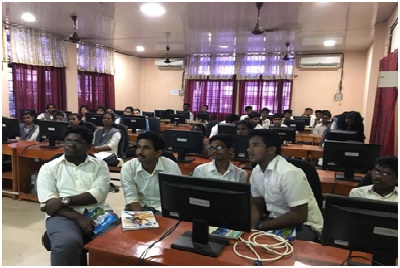
Higher Semester students taking awareness class for first semester electrical students about Arduino –an open source electronic prototyping platform enabling users to create interactive electronic objects.
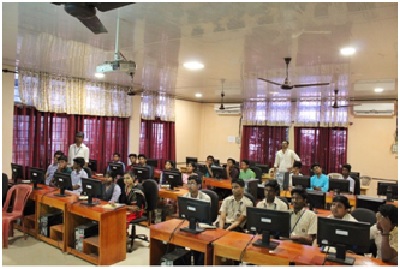
Handling class for Pre-University Students
A group of students evaluate the energy audit of College of Engineering Perumon in the year 2016 and submit a report regarding the limitations of current strategies adopted in our institution. The need to reduce energy costs is a crucial business practice for successful organizations, and energy audits have begun to play a more significant role in managing energy expenses. An energy audit help to determine the energy wasting deficiencies in the institution and can show exactly how to address those problems.
Substation:Faculties take initiative to conduct a real time class about substation and its major equipment.
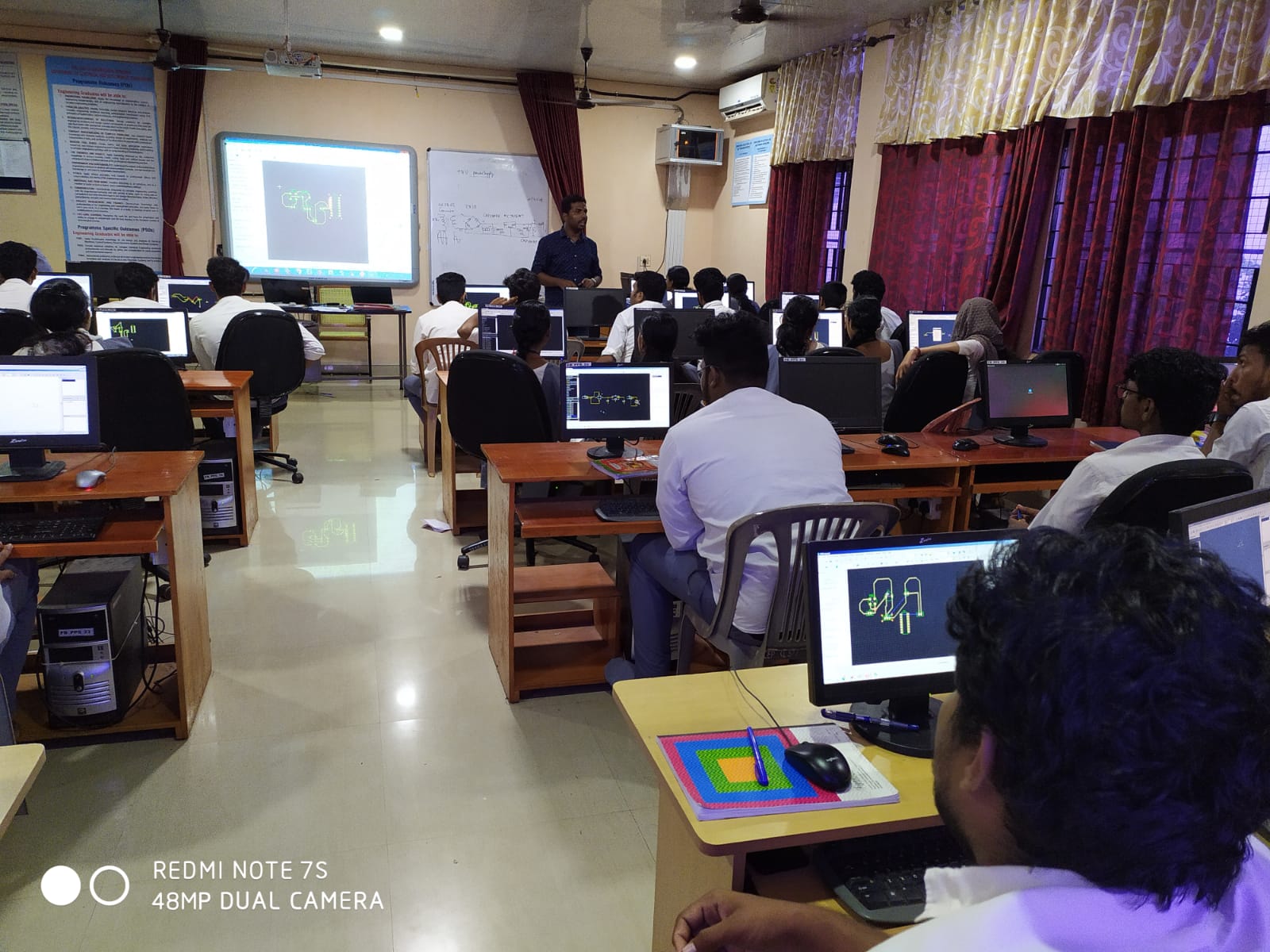
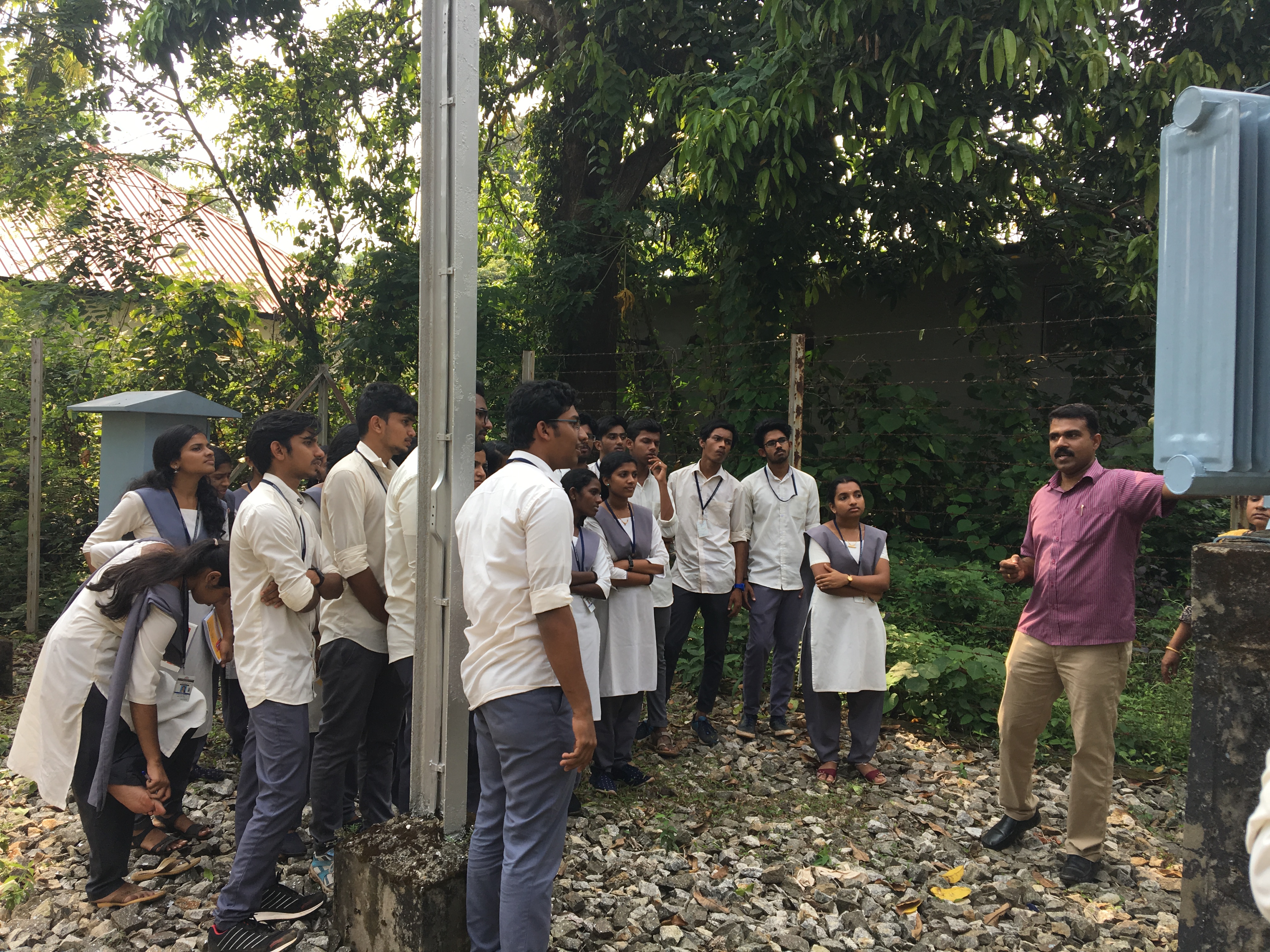
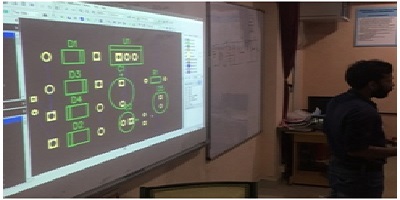
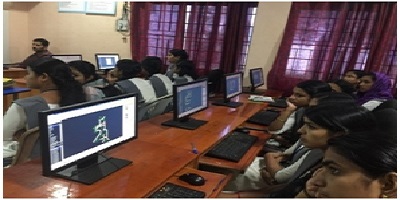
Our Dept is solar powered zone. Electrical staff room and class room s are powered from PV panels.Solar power is pollution free clean power that is available every day of the year. even cloudy days produce some power.
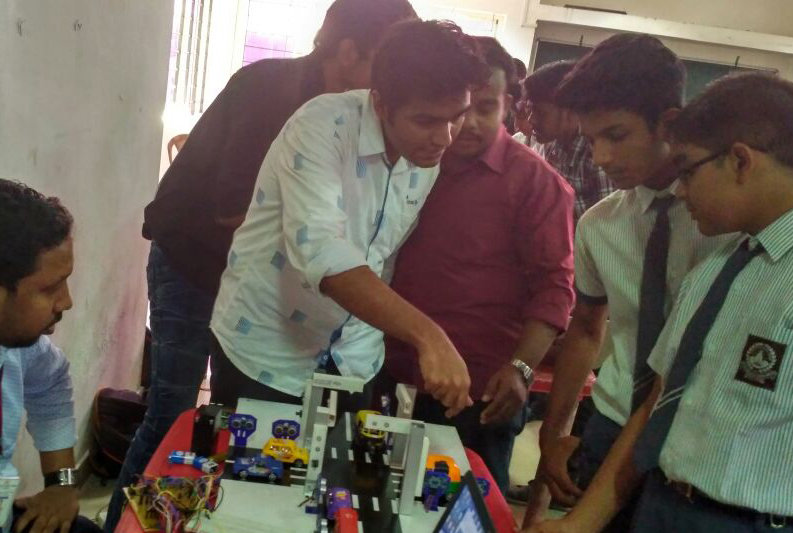
Project Based Learning: Faculty give course project as assignments to a group of students to improve their technical knowledge, coordination and teamwork among students. Also the students are encouraged to participate in several Inter institute National Level and State level Project Exhibition, Competition etc.
UVOS-Ultra Violet Ozone Based Sterilizer was developed during pandemic time to sterilise bags and other accessories inorder to keep safe from virus and other germs.
E-thaap –an automatic temperature sensing device was developed for monitoring Covid 19 patients.
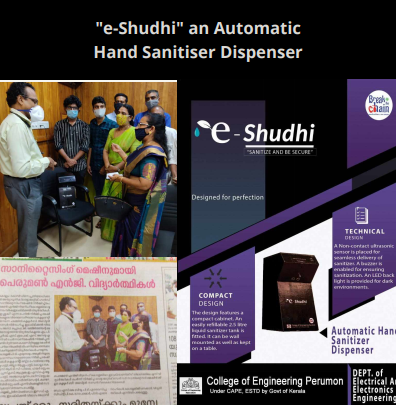
E-Shudhi - Automatic Sanitizer dispenser unit was developed during the initial period of pandemic. Initially 25 units were developed in the first phase and distributed to various government firms and hospitals. Later the model was redesigned and 30 units were developed in the second phase as per the requirements from public health centre, government offices, and educational institutions across Kerala, Tamil Nadu and Delhi.
Robio-a Convalescent Robot was developed for monitoring oxygen, pressure, temperature of covid patients. It also assists for giving medicines and food for covid-19 patients.This work was selected for National RFID Challenge 2021.
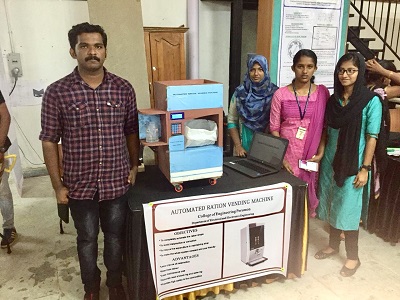
Kerala State Institute of Design Innovation Awards 2018-19: Project work of five batch students are shortlisted for participating in the Orion Kerala State Institute of Design Innovation Awards. Secured 4th & 7th Orion Kerala State Institute of Design Innovation Awards for the project titled ‘Automatic Ration Vending Machine’ and ‘Integrated Smart Bin’. Project work of four batch students are shortlisted for participating in the Traffic Expo organized by Kerala Police in 2017-18. Secured 3rd position for the project titled ‘Automatic vehicle collision avoidance system’ .
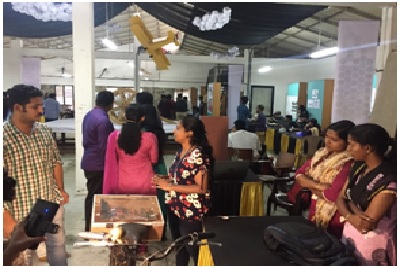
Secured 4th & 7th Orion Kerala State Institute of Design Innovation Awards for the project titled ‘Automatic Ration Vending Machine’ and ‘Integrated Smart Bin’.
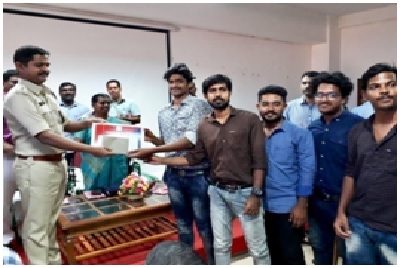
3rd Prize Safety Based Project titled” Automatic Vehicle Collision Avoidance System
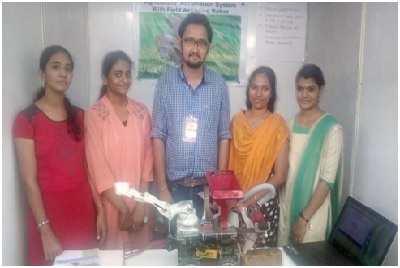
AGROBOT- Agriculture Automation System
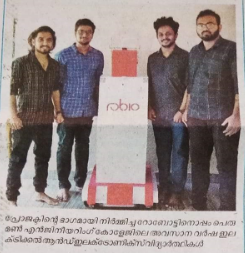
Robio - a Convalescent Robot
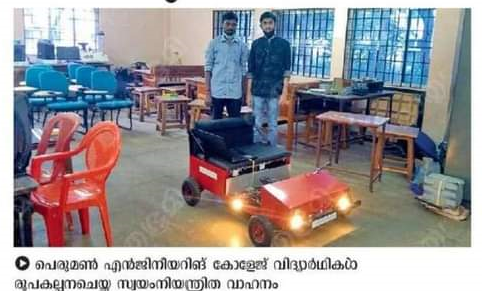
Electrical Vehicle
Undergraduate students are encouraged to present their research in several international and national conferences, and also publish the same in National as well as International Journals.
"For suggestions Kindly mail to eeecep@perumonec.ac.in "